For psychiatrists, psychiatric NPs, and med-management practices
Psychiatry billing that follows every visit to your bank.
Med checks are short, frequent, and often billed with a therapy add-on code. That's a lot of small claims, and a lot of places for money to slip. Remitra follows each visit from the claim to the deposit, so you can see what's paid and what's stuck.
- VisitThu, 8:30 · 99214 + 90833
- Bill senttwo lines, one claim, same day
- Add-on not paidmed check paid · therapy line denied
- In your bank$96.20 of $158.70 so far
Illustrative example. Remitra shows the half-paid visit on its own, instead of letting it pass as “paid.”
Does this sound familiar?
Twenty visits a day. No idea which ones paid.
- “We see clients every few weeks for meds, and I can't tell which visits insurance actually paid.”
- “The claim says paid, but the deposit looks low. I don't have time to dig into why.”
- “Prescribing is in one system, notes in another, and billing in a third.”
Where the money goes
Where psychiatry practices lose money.
Med-management clients come back every few weeks for years. A small billing mistake doesn't happen once. It repeats at every visit until someone catches it.
-
The therapy add-on quietly goes unpaid.
When you do therapy during a med visit, it's billed as a second line (90833, 90836, or 90838) next to the med-check code. Insurance can pay the med check and deny the add-on. The claim looks paid, so nobody notices the missing part.
How Remitra shows it
What insurance paid is kept line by line, with the reason for any line that wasn't paid. A $0 add-on stands out instead of hiding inside a “paid” claim.
-
Coverage changes between med checks.
A client who comes in every month can change jobs or plans between visits. If insurance was only checked at intake, the next several visits get billed to a plan that no longer covers them.
How Remitra shows it
Insurance is checked before every visit, not just the first one, so a change shows up before the appointment.
-
Small copays pile up.
A $20 copay feels too small to chase at the end of a 20-minute visit. Twelve visits later, the client owes $240 and nobody wants to bring it up.
How Remitra shows it
The client's balance is on screen at check-in and can be paid by card in seconds. Statements and online payment links go out automatically.
-
Denials sit until the deadline passes.
Insurers give you a limited window to fix and resend a denied claim. With dozens of short visits a week, a few denials get buried and the window closes.
How Remitra shows it
One list of every denied claim with the reason in plain English, and money you're still owed sorted by age, so the oldest gets handled first.
Follow one visit
A med check with therapy, from the visit to the deposit.
This is how a typical 99214 + 90833 visit moves through Remitra. The dollar amounts are illustrative.
- 1VisitA 25-minute med check with 18 minutes of therapy. The note is signed and e-prescriptions are sent from the same screen.
- 2BillOne claim with two lines, 99214 and 90833, sent to the insurer when the note is signed.
- 3Insurance payment$96.20 paid on 99214. 90833 denied, with the reason shown in plain English.
- 4Fix and resendThe add-on is corrected and resent from the denial list, before the deadline.
- 5Bank depositBoth payments are matched to this visit, and the $20 copay was collected at check-in.
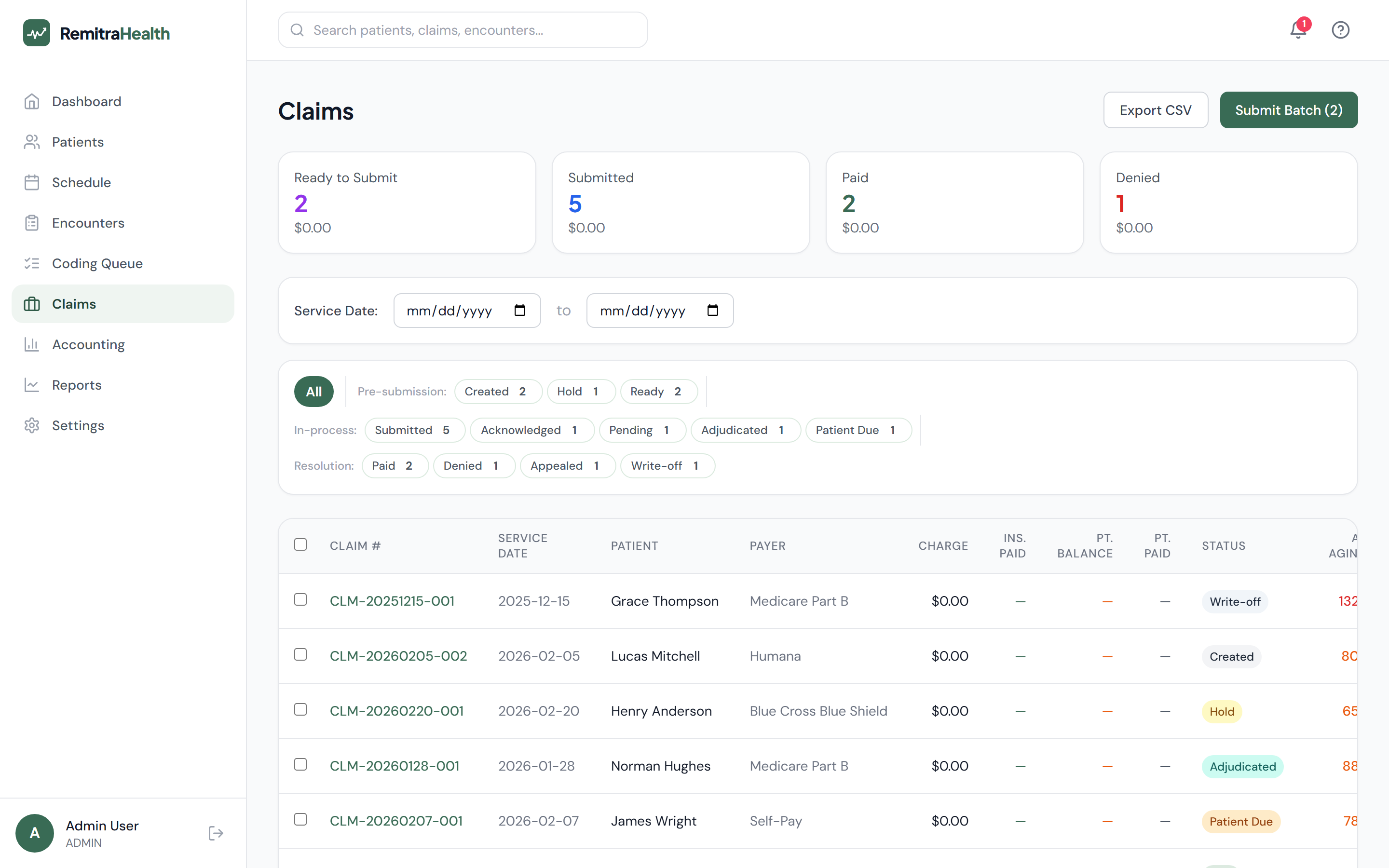
For whoever does the billing
Psychiatry billing codes you use most.
The codes that make up most psychiatry and med-management claims, and the snag that most often trips each one up.
| Code | What it means | Common snag |
|---|---|---|
| 99213 · 99214 · 99215 | Follow-up visit with an established client (a med check). The level reflects how complex the decision-making was, or the total time. | The level billed doesn't match what the note supports. |
| 90833 · 90836 · 90838 | Therapy added to a med visit: 16–37, 38–52, or 53+ minutes of therapy. | Therapy time isn't recorded separately from the med-check time, so the add-on is denied while the med check is paid. |
| 90792 | Psychiatric evaluation with medical services, usually the first visit. | Some insurers limit how often it can be billed for the same client. |
| 90791 | Psychiatric evaluation without medical services, often done by a therapist in the same practice. | Billed under the wrong clinician, or on the same day as a med visit. |
| 90837 | A therapy-only session of 53 minutes or more. | The time in the note doesn't support the code. |
Codes are CPT® codes from the American Medical Association. Insurer rules vary, so check each payer's policy.
Questions
Psychiatry billing questions.
Can I bill a med check and a therapy add-on code on the same claim?
Yes. A visit like 99214 with 90833 goes out as one claim with two lines. Remitra keeps what insurance paid on each line separately, with the reason for any line that wasn't paid, so a denied add-on doesn't hide inside a claim that otherwise looks paid.
Does Remitra include e-prescribing?
Yes. E-prescribing runs through Surescripts and is EPCS-certified for controlled substances, so prescribing lives in the same system as your notes and billing.
Is insurance checked before every med-management visit?
Yes. Eligibility is checked before every appointment, not just at intake. Med-management clients are seen often, so a change in coverage shows up before the next visit instead of after several have been billed to the wrong plan.
Can I see what each psychiatrist or nurse practitioner collects?
Yes. Reports show what each clinician billed and what was actually collected, so you can see who is busy and whether that work is turning into deposits.
Can I sign up today?
Remitra is in private preview and working with a small group of mental health practices. Book a 30-minute demo call and we'll walk through how billing works at your practice today.
30 minutes · Free · No commitment
See how Remitra would work for your psychiatry practice.
Book a short video call. We'll learn how billing works at your practice today, and show you a med-management visit tracked all the way to the bank deposit.
Book a demo callOpens Google Calendar in a new tab. No client data needed — we use sample data.