Remitra Health

For therapists, psychiatrists, and group practices — and whoever handles the billing

Follow every session all the way to your bank.

Your EHR knows who you saw. QuickBooks knows what hit the bank. Nothing connects the two — so denied claims, unpaid copays, and missing insurance payments slip by unnoticed, week after week. Remitra connects them, so you can see exactly where every dollar is, in plain English.

Free · 30 minutes · No commitment

  1. SessionTues, 9:00 · 53 min · Dr. Lin
  2. Bill sentto Aetna, same day
  3. Insurance said nowrong session code · fix & resend
  4. In your bank$118.40 — not yet

Remitra tracks every session like this — and flags the ones that get stuck before they cost you.

Does this sound familiar?

You're busy. The money is a mystery.

You trained to help people, not to become a billing expert. Most of the therapists and psychiatrists we talk to say some version of this:

  • “My caseload is full, but the bank account doesn't show it.”
  • “I see clients back to back, then do the billing at night.”
  • “Insurance sends us letters and I can't tell if we owe them or they owe us.”
  • “I hate asking clients for money, so their balances just keep growing.”
  • “My accountant asks for reports and I don't know where to find them.”
  • “An insurer denied the same client's sessions for weeks before anyone noticed.”

None of this means you're doing something wrong. It means your systems don't talk to each other.

The gap nobody connects

Your sessions live in one place. Your money lives in another.

Most practices run on an EHR for the clinical side and QuickBooks for the money side. They were never built to talk to each other — so nobody can trace a session to the dollar that paid for it.

Today

  • Your EHR Who you saw, and for how long.
  • Your biller or clearinghouse What was billed. What got denied — maybe.
  • QuickBooks & your bank Deposits — with no idea which session they're for.

So when a $118 deposit lands, nobody can tell you which client it's for, whether it's the full amount, or what's still missing.

With Remitra

  1. 1
    SessionDr. Lin sees a client for a 53-minute therapy session.
  2. 2
    BillSent to Aetna automatically when the note is signed.
  3. 3
    Insurance payment$118.40 paid · $30 is the client's share.
  4. 4
    Bank depositMatched to this exact session — automatically.
  5. 5
    Your monthly reportBilled, collected, and still owed — all adding up.

Every deposit is matched to the session it paid for. Anything that didn't get paid shows up on its own.

What the gap costs you

Where the money quietly goes.

Mental health practices see the same clients every week — so one billing mistake doesn't happen once, it happens every session until someone catches it.

  1. The same denial, every single week.

    Therapy is billed by session length. If the time in the note doesn't match the code billed, or a telehealth session goes out coded as in-office, insurance says no — and keeps saying no to every session after it. Most of these can be fixed and resent. Most never are.

    65% of denied claims are never resubmitted.1

    How Remitra shows it

    One list of every claim insurance turned down, why they said no, and what to do next — so a repeating error gets fixed once, not fifty times.

  2. The client's share never gets collected.

    Nobody wants to talk about money at the end of a hard session. So a $30 copay gets skipped, then another, and by spring a client owes hundreds — which is even harder to bring up.

    Practices typically collect only 50–70% of what patients owe after they leave.2

    How Remitra shows it

    What the client owes is on screen at check-in, so it can be paid by card in seconds. Statements and online payment links go out automatically — you don't have to be the one who asks.

  3. Coverage changes in the middle of treatment.

    Clients switch jobs, change plans, or hit a new deductible in January. If insurance was only checked at intake, months of sessions can be billed to coverage that no longer applies.

    How Remitra shows it

    Insurance is checked before every session, not just the first one — so a change shows up before the next appointment, not after twelve.

  4. Money you were owed quietly expires.

    Insurers only give you a set window to bill and follow up — some as little as 90 days. A claim that sits in a pile past that date is gone for good.

    Nearly 4 in 10 practices say at least one in ten claims gets denied — and each one has to be fixed before that deadline.3

    How Remitra shows it

    “Money you're still owed,” sorted by how old it is — so the oldest gets chased first, before time runs out.

  5. Nobody knows which numbers are real.

    The billing report says one thing, the bank says another, and the accountant has a third number. So decisions about hiring another clinician or raising your rates get made on gut feel.

    How Remitra shows it

    One monthly report — billed, collected, still owed — that matches your bank to the penny.

  1. Change Healthcare Revenue Cycle Denials Index, as reported by HFMA.
  2. McKinsey & Company research on patient collections, as cited by Healthcare Dive.
  3. Experian Health, State of Claims 2024.

How it works

One system, from the front desk to the bank.

Scheduling, notes, billing, and the books all live in Remitra — so nothing gets lost in the hand-off between them.

Before the session

Know what the client owes before they sit down.

Remitra checks their insurance before every appointment, so you (or your front desk) know the copay and any old balance before the session — not three weeks later.

  • Insurance checked before every session
  • Client's share shown at check-in
  • Collect by card on the spot
  • Online intake forms before they arrive
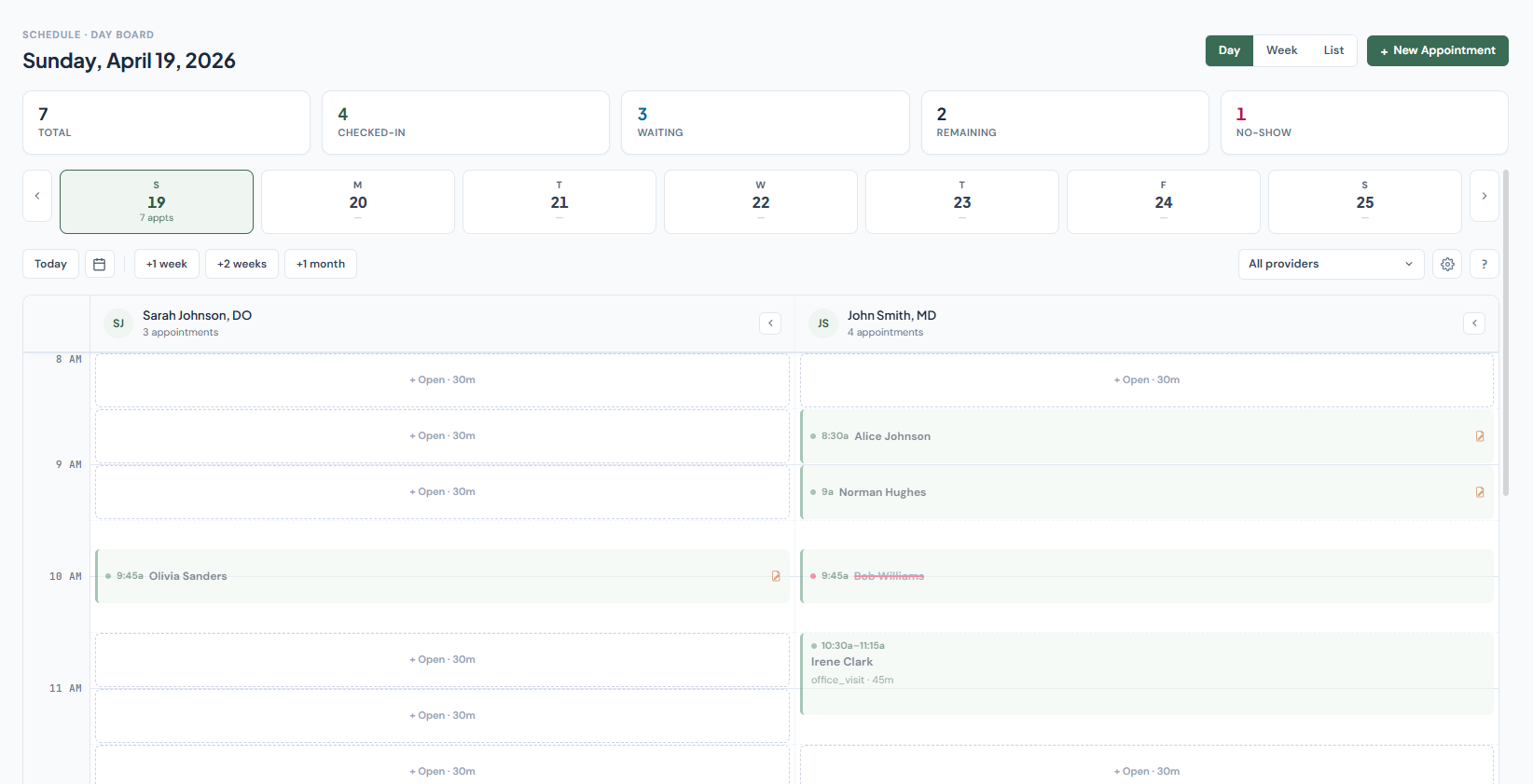
Daily schedule with appointments and status pills

After the session

Notes that send the bill for you.

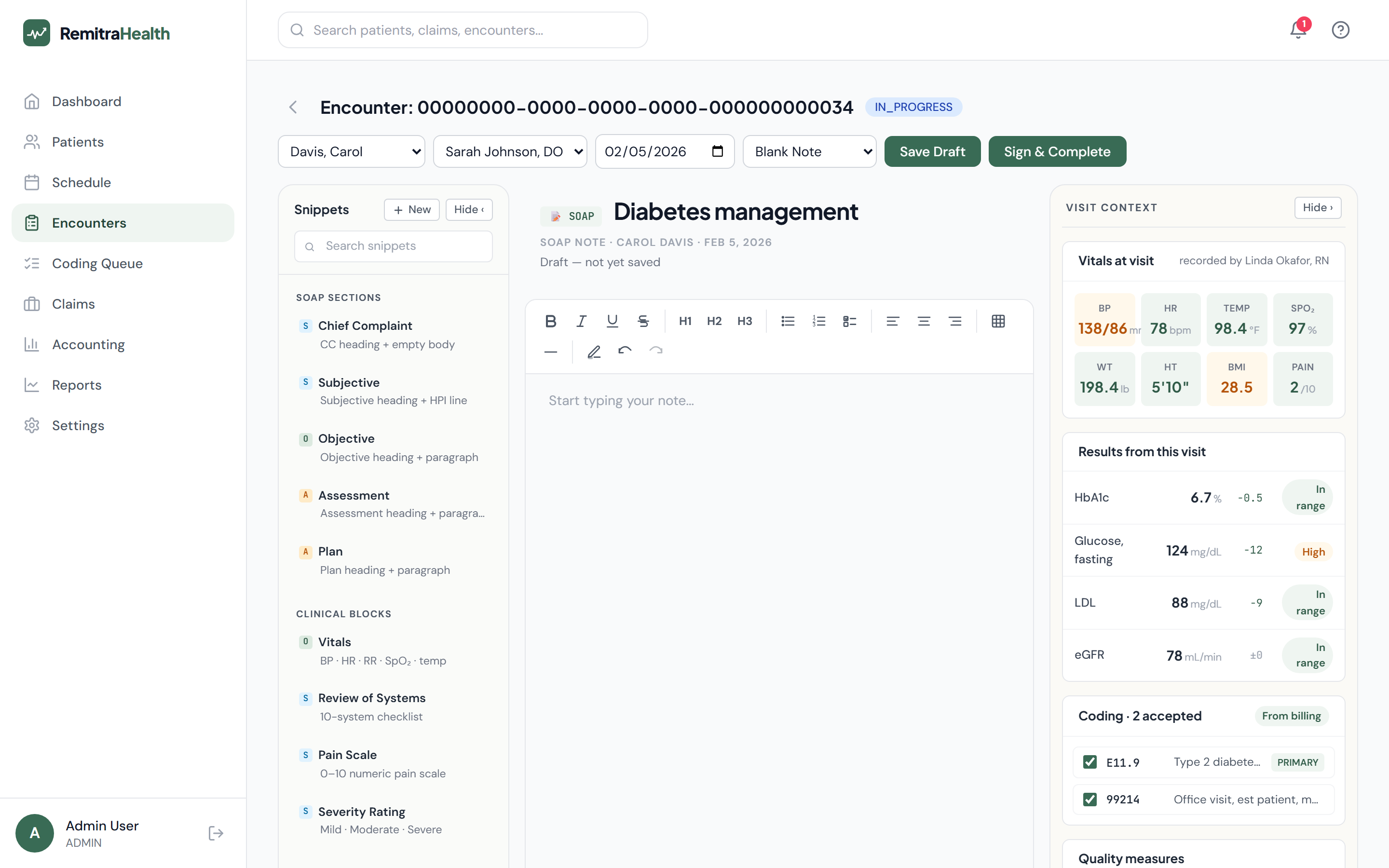
Write your progress note the way you already do. When you sign it, the bill is built and sent automatically — no re-typing, no sticky notes for the biller.

  • Note templates you shape to how you write
  • Signing the note sends the bill
  • Corrections tracked properly
  • In-person and telehealth sessions
Session note editor with billing codes

With insurance

Every claim tracked until it's paid.

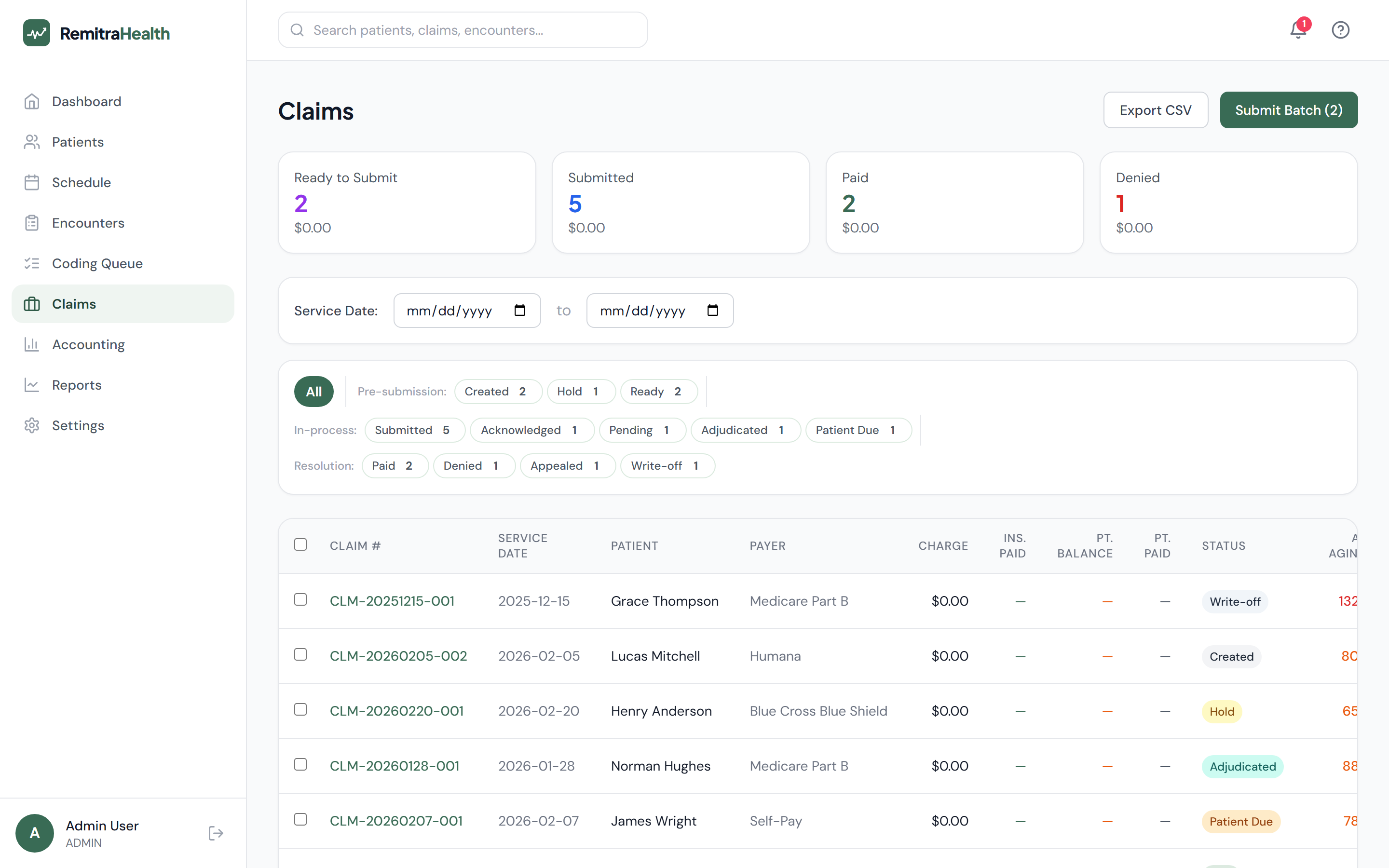
Bills are checked for common mistakes before they go out. If insurance says no, it lands on a to-do list with the reason and the next step — it never just disappears.

  • See which claims are stuck, and why
  • Know exactly what insurance paid
  • Statements and online pay for clients
  • Nothing falls through the cracks
Claims list showing status, totals, and denial reasons

In your bank account

Every deposit matched to the session it paid for.

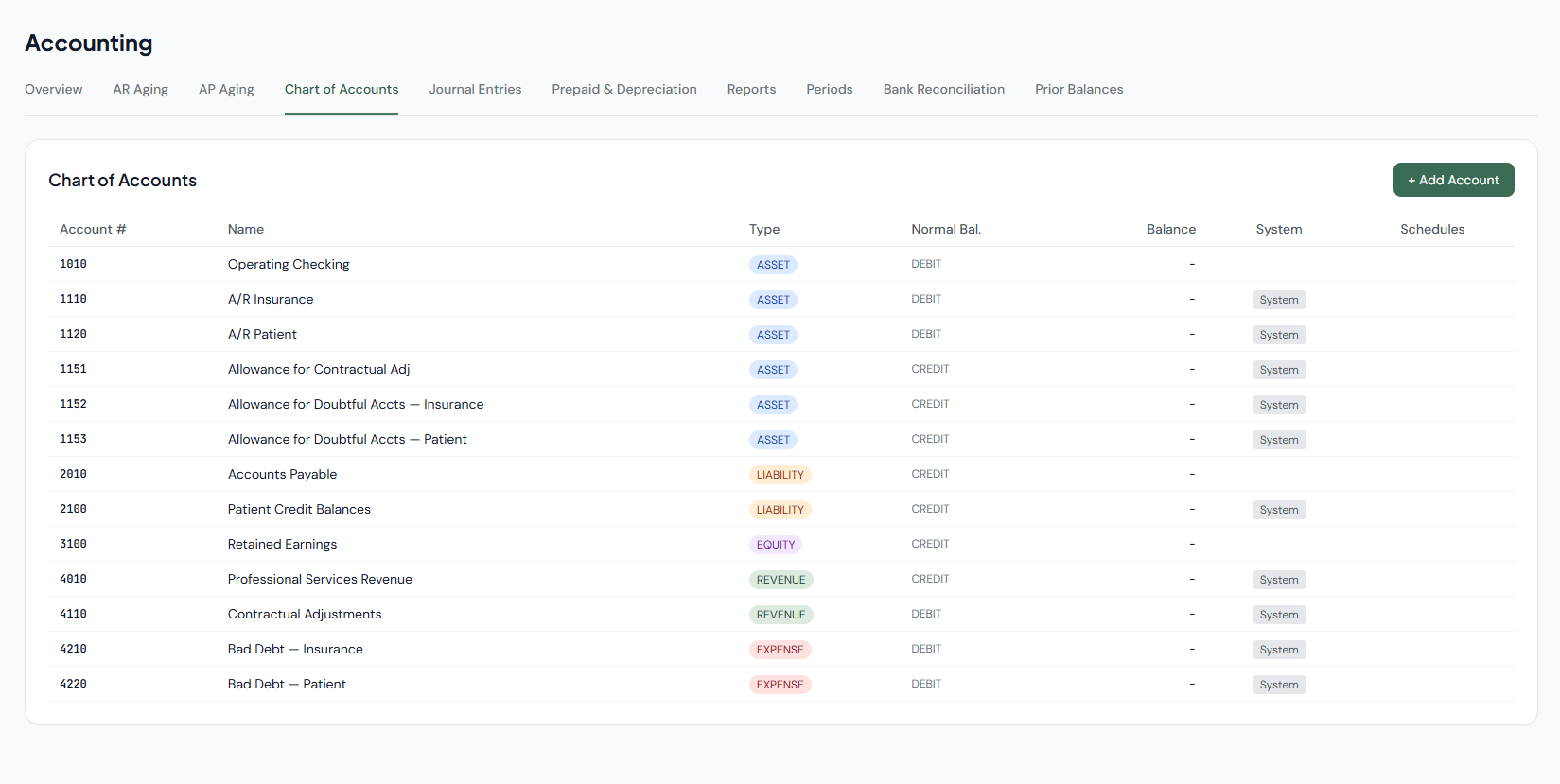
Insurance and client payments flow straight into your books. Each month you get one clear report: how much you billed, how much you collected, and how much you're still owed.

  • Bank deposits matched automatically
  • A monthly report you can actually read
  • Money owed to you, sorted by age
  • Works with QuickBooks, your bank, and card payments
Financial reports connected to billing activity

Your choice

You see it. Or we handle it.

See it yourself

Finally understand your numbers.

Open Remitra and see three answers right away: how much you billed this month, how much you've collected, and how much you're still owed — and which sessions it's from.

Hand it off

Don't want to learn billing? You don't have to.

Our team runs your billing and follow-up for you, then walks you through what happened each month in plain English. You stay in the loop without doing the work.

Pricing

How much do you want to hand off?

Every option includes the full Remitra system. The only question is how much of the work you want us to do.

What you get

Every option includes everything in Remitra — no surprise add-ons, no per-user fees.

01 Software

You (or your staff) do the billing, with clear tools.

  • All of Remitra — scheduling, notes, billing, and the books
  • As many users and locations as you need
  • We set it up and move your data over
  • Help during business hours

Your team does the billing and books.

Book a demo

02 Billing

We do the billing. You see exactly what's happening.

Everything in Software, plus:

  • We send your claims and record what insurance paid
  • We chase denied claims and money you're owed
  • We handle client bills and payment plans
  • A named person who knows your practice
Book a demo
The software
Scheduling, notes, billing, and the books
As many users and locations as you need
Setup and moving your data over
Getting paid by insurance & clients
Sending claims and recording what insurance paid
Your team
We do it
Chasing denied claims and money owed
Your team
We do it
Client bills and payment plans
Your team
We do it
Your books
Keeping the books and matching them to your bank
Your team
Your team
Closing out each month and preparing reports
Your team
Your team
A call to walk through your numbers
—
—
Help
Help during business hours
A named person who knows your practice
—

Not sure which fits? We'll help you figure it out on a call.

Not sure which fits? We'll help you figure it out on a call.

Billed monthly in USD. Discount for an annual software subscription.

For your accountant or biller

The technical details, for the people who'll ask.

Forward this page to your accountant or billing team — everything they'll want to check is below.

Claim-to-cash: how a visit reaches the general ledger

Most platforms hand you a billing system and leave you to match it to separate accounting software. At month-end one team exports CSVs, another hand-keys entries from the 835, and neither set of books ties out. Remitra carries every claim, ERA, write-off, and patient payment all the way into your general ledger, with bank reconciliation against the GL.

  1. 01
    Encounter signed90837 · F41.1 · Dr. Lin
  2. 02
    Claim built & submitted837P · Aetna PPO · scrubbed clean
  3. 03
    ERA posted$118.40 received · $30 patient responsibility
  4. 04
    Journal entry writtenJE-1042 · 4010 · trial balance updates
Billing & accounting capabilities
  • Real-time eligibility (270/271) on every appointment
  • Automated 837P generation, line-level, with payer-rule scrubbing
  • ERA (835) posting with adjudication detail
  • Denial workqueues with CARC/RARC reason codes
  • Patient statements, payment plans, Stripe card & ACH
  • Auto-generated journal entries from clinical and billing events
  • Bank reconciliation against the GL (Plaid-linked accounts)
  • Drillable income statement and balance sheet
  • A/R and A/P aging; month-end close with period locking
  • GL export to QuickBooks Online, Xero, or CSV
Clinical notes editor

Notes are built on a modern rich-text editor — the same kind of engine behind Notion-style documents — so the cursor goes where you expect, formatting works the first time, and there are no pop-up mazes.

  • /
    Slash commandsPull up templates and codes without leaving the keyboard.
  • ↹
    Templates that stay editableNo locked sections, no "click to expand."
  • ⌘ ↵
    Sign-off triggers the claimNo double entry, no swivel-chair to billing.
Integrations

Clearinghouses

  • Availity
  • Waystar
  • Change Healthcare

E-prescribing (psychiatry)

  • Surescripts
  • EPCS-certified for controlled substances

Payments

  • Stripe (cards & ACH)
  • Plaid bank linking

Accounting export

  • QuickBooks Online
  • Xero
  • CSV / GL JE export

Patient engagement

  • Native portal & telehealth
  • SMS / email statements

Questions

Common questions about Remitra.

What is Remitra?

Remitra is billing and bookkeeping for mental health practices. It follows every session from the claim to the bank deposit, so you can see what you billed, what you've been paid, and what's still missing, in plain English.

Who is Remitra for?

Outpatient mental health practices that bill insurance: solo therapists, group practices, psychologists, psychiatrists and psychiatric NPs, LPCs, LCSWs, and marriage and family therapists, including telehealth practices. It's also built for whoever handles the billing, whether that's the owner, a spouse, or an office manager.

Does Remitra replace my EHR?

It can. Remitra includes scheduling, clinical notes, claims, client payments, and the books in one system, so a signed note becomes a claim and the insurance payment lands in your books without re-typing anything.

Do I still need QuickBooks?

Not for day-to-day bookkeeping. Remitra keeps a general ledger, matches it to your bank, and produces an income statement and balance sheet. If your accountant prefers their own system, Remitra exports to QuickBooks Online, Xero, or CSV.

Can Remitra do the billing for me?

Yes. With the Billing option, our team sends your claims, records what insurance paid, chases denials, and handles client bills. With Billing + Books, we also keep your books and close each month. Or use the Software option and do it yourself.

Is Remitra HIPAA compliant?

Remitra is built with HIPAA safeguards: role-based access, required two-factor sign-in, encryption, and audit logs that can't be edited. We sign a Business Associate Agreement with every practice before handling its patient data (how we protect data). Remitra is in private preview, so demos use sample data.

How much does Remitra cost?

It depends on which option you choose and how much you bill. There are no per-user fees and setup is included. See the pricing page for what each option includes, and book a demo call for a quote.

30 minutes · Free · No commitment

Let's talk about where your money goes.

Book a short video call. We'll learn how billing works at your practice today, and show you how Remitra follows every session all the way to your bank.

  1. 1
    Pick a timeChoose a 30-minute slot that works for you.
  2. 2
    Tell us how billing works todayWho does it, which systems you use, and what's frustrating.
  3. 3
    See Remitra in actionWatch a session get tracked all the way to the bank deposit.
Book a demo call

Opens Google Calendar in a new tab. No client data needed — we use sample data.